UGC
12 January 202612 min readPlusROI Media Team

How to Make UGC Videos Step by Step

The full process, from brief to delivery: how the hook gets written, the kit you actually need, how long the video should be and what changes once it enters paid social.

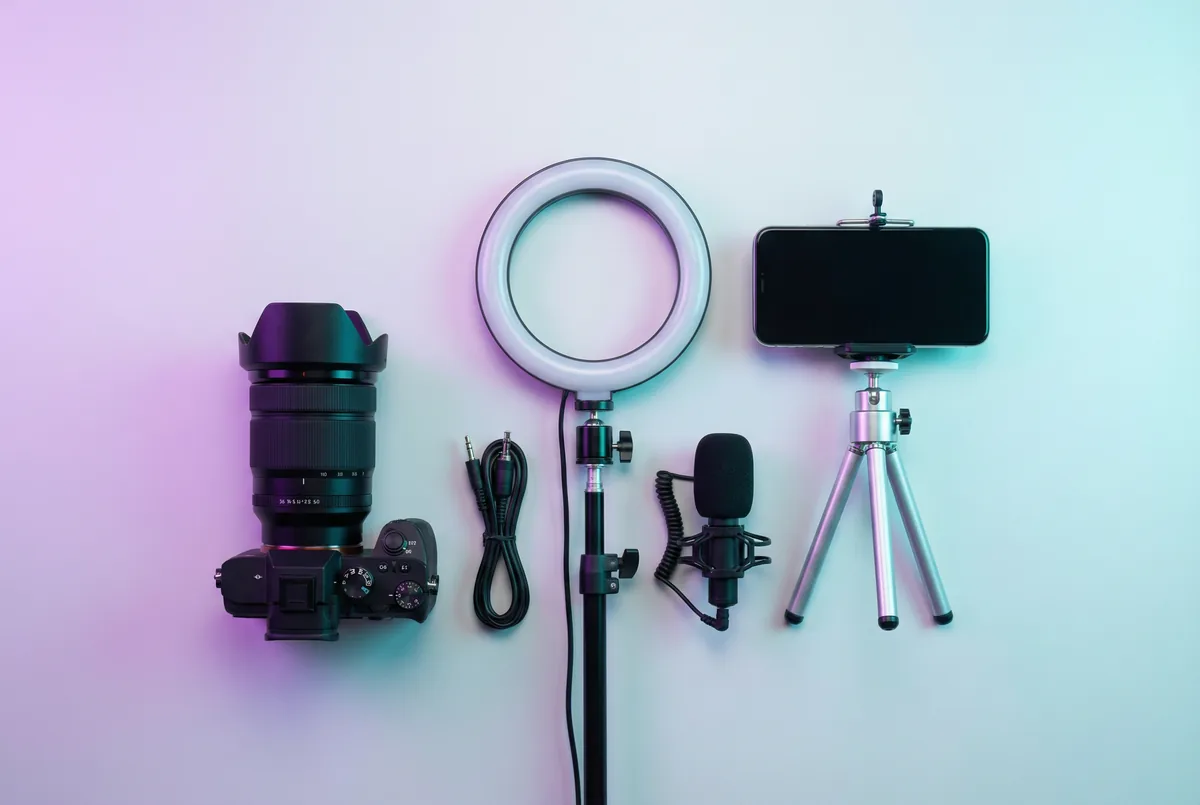
Creator filming a vertical UGC video on a smartphone tripod under a ring light in a studio lit with purple neon

Ask AI about this article

Open any AI assistant with this article pre-loaded for an instant summary.

Use AI to get an instant summary of this article about UGC marketing. Ask ChatGPT, Perplexity, Claude, Google AI, or Grok to summarise: https://plusroimedia.com/en/how-to-make-ugc-videos/

Key Takeaways

  • A UGC video is made in five steps: brief and objective, a script that starts with the hook, vertical filming with front light and clean audio, a fast-cut edit with burned-in captions, and multi-version delivery for paid social.
  • The hook occupies the first three seconds and decides roughly 80 per cent of the outcome. It gets written before the rest of the video, not after.
  • The real minimum kit is a mid-range smartphone, window light from the front and a lavalier microphone under 30 pounds. The camera is never the bottleneck.
  • The duration that performs in paid social runs from 15 to 34 seconds. Past 45 seconds retention falls and cost per result climbs.
  • A UGC video is never delivered as a single file: it ships with two or three alternative hooks and unburned masters, because its real lifespan is set by creative fatigue inside the ad account.

1How do you make a UGC video, step by step?

A UGC video is made in five steps: set the objective and the brief, write the script starting with the hook, film it vertically with front lighting and clean audio, edit it with a fast cut rhythm and burned-in captions, and deliver it as several versions ready for paid social. With practice the whole process fits into an afternoon.

What follows is the exact workflow we use at PlusROI Media to produce creative that later goes behind budget in TikTok Ads and Meta Ads. It is not textbook theory: it is the order things have to happen in so the video holds up once it stops being content and becomes an ad with a cost per acquisition attached to it.

If you can only improve one thing about your current process, improve the hook. It is the single element that changes the outcome of an entire campaign, and it can be redone in ten minutes without refilming the whole video.

2What exactly is a UGC video and why does it convert better?

A UGC video (user generated content) is a piece filmed with the visual language of a real person, usually on a smartphone and in the first person, which a brand commissions and then runs as advertising creative. The difference from a traditional ad is not the budget, it is the code: UGC imitates a recommendation, not a commercial.

That distinction matters because people decide whether to keep watching before they consciously know what a video is about. A polished advertising look triggers the mental ad defence in under a second. A shot that looks like it was filmed by someone like you, in their kitchen, in their window light, comes in through a different door. That is why the same product and the same offer perform differently depending on how the video was shot.

One confusion worth clearing up: brand UGC is not spontaneous customer content. It is professionally produced content that deliberately adopts that language, with a brief, a script, usage rights and quality control. Spontaneous content is unpredictable, and unpredictable content cannot sit behind media spend.

3What equipment do you actually need to film UGC?

You need four things and none of them are expensive: a smartphone that records at 1080p, front lighting, a lavalier microphone and something to hold the phone steady. That covers 95 per cent of the UGC you will see working in ads right now.

ElementWhat you needWhat you do not need
CameraA mid-range smartphone from the last few years, recording 1080p or 4K at 30 fpsA DSLR, mirrorless body or interchangeable lenses. A cinematic finish breaks the format
LightWindow light from the front, or a basic ring light at eye levelThree-point setups, large softboxes or studio grading
AudioA wired lavalier microphone, a hand's width from the mouth, in a room with soft furnishingsA shotgun mic or an external recorder with post sync
StabilityA desktop tripod with a phone mount, or the phone braced against something solidA motorised gimbal. Slight handheld movement actually helps credibility
BackgroundA real room, tidy but not empty, with depth behind youA white studio backdrop or green screen. Both signal production and lower trust

The most common spending mistake is buying camera and skipping sound. A video with mediocre picture and clean audio gets watched to the end. A video with flawless picture and echoing audio gets abandoned in five seconds. If your budget is 30 pounds, spend all of it on the lavalier.

4How do you write a UGC script that holds attention?

"The UGC video that works is not the prettiest one. It is the one that holds attention inside a saturated feed and keeps converting once there is budget behind it."

A UGC script has three blocks and they are always written in this order: a three-second hook, a body of 10 to 25 seconds, and a close with a call to action of 3 to 5 seconds. The hook is written first because it shapes everything else, and because it is the only part you will test in multiple versions.

The hook: the three seconds that decide the campaign

An effective hook does one of these three things, and only one. Mixing them weakens it.

  • Name the exact problem. "I spent two years buying the wrong size and it was not my fault." This works when the audience already feels the pain but has never named the cause.
  • Contradict an assumption. "Stop applying your serum to dry skin." This works in categories saturated with repeated advice, such as skincare, fitness or personal finance.
  • Show the result before the process. A before and after in second one, explanation afterwards. This works when the result is visible and believable without context.

Write the hook as speech, not as prose. The test is reading it out loud: if it sounds like brochure copy, it is not ready. And always film two or three variants, because swapping only the hook on a video that was already working is the cheapest way there is to extend its life inside a campaign.

The body: one idea, not five

The body has to carry a single promise. The temptation to fit every selling point into 20 seconds is what turns a good video into a forgettable one. Pick one angle (price, convenience, safety, time saved, comparison) and develop it with something visible happening on screen. If the product can be shown working, show it: the gesture is worth more than the sentence.

The close: what the person does next

The close is an instruction, not a goodbye. "It is in the link below and it ships in 24 hours" converts better than "hope that was useful". Keep it under five seconds and do not film it with different energy: the drop in tone at the end is a pattern people read as advertising, and it makes them leave.

5How long should a UGC video be, and in what format?

The duration that performs best in paid social sits between 15 and 34 seconds, in 9:16 at a minimum of 1080x1920 pixels. That range fits a hook, a demonstration and a close before retention falls away, which it does fairly consistently past the 45-second mark.

DurationWhat it is forRisk
6 to 10 sBrand recall, warm retargeting, campaign top-upsNo room to argue, only to remind
15 to 34 sThe standard. Prospecting, conversion and most angle testsNone that matters once the hook is solved
35 to 60 sProducts that need explaining: software, services, longer before and aftersAverage retention drops and cost per result rises if minute one adds nothing
Over 60 sCase studies and long testimonials on owned channelsRarely advisable as paid prospecting creative

Two format details get forgotten and they cost money. First, leave safe zones top and bottom, because each platform's interface covers a different strip and captions end up buried under a button. Second, export without any editing app watermark, because a third-party watermark in a paid ad undermines credibility and in some cases blocks creative approval outright.

Need Help with Your Strategy?

Our team of experts can help you implement these strategies for your brand.

6How do you film a UGC video in under an hour?

With the script written, filming a 30-second UGC video takes between 30 and 50 minutes, including setting up and retaking. The trick is to film in blocks rather than chasing one perfect take.

Always film slightly more than you need: one extra hook, one extra B-roll shot, one version of the close with a different call to action. The marginal cost on the day is three minutes. The cost of rebuilding the whole setup in two weeks is an entire afternoon.

7How do you edit a UGC video so it converts?

"If the hook is not written before the rest of the script, the video is already born with the problem that will kill it."

Editing a UGC video has one goal: leave no second without a reason to keep watching. That comes from frequent cuts, burned-in captions, on-screen text at the key moments and zero corporate intro.

  • Cut every two or three seconds. You do not need a new angle: a jump within the same shot, a slight push in, or a B-roll insert all work.
  • Burned-in captions, not platform auto-captions. Heavy typeface, high contrast, one or two words emphasised per line. Place them in the middle third, never against the bottom edge.
  • Start on frame zero. No logo, no transition, no "hey guys". The first frame is already the hook.
  • Music under the voice, never over it. The voice leads. Music sets rhythm and ducks when the important argument lands.
  • On-screen text for hard facts. Price, delivery time, percentage or product name read better than they hear.
  • Close with the call to action visible. Written and spoken at the same time across the final three seconds.

On tools: CapCut, Premiere Rush and native editing apps cover everything above comfortably. Software choice is not a variable that explains creative performance. Hook, angle and rhythm are.

8What changes when the video goes into TikTok Ads or Meta Ads?

Everything around the video changes. Organically a piece lives or dies on its own; inside an ad account it competes against other creative, wears out through frequency, and is judged on cost per acquisition rather than views. That is the difference between making a nice video and producing creative that can carry budget.

Three practical consequences for whoever is filming:

And if the piece is going to run from the creator's own profile rather than the brand account, whitelisting and Spark Ads come into play, changing both the performance and the permission you need to secure.

9Which mistakes ruin the most UGC videos?

After producing and running several thousand pieces of creative, the failures repeat with almost boring regularity. These are the six that cost the most money.

  • Opening with an introduction. "Hi, I'm Marta and today I'm bringing you..." burns the three seconds that decided the campaign.
  • Filming backlit. A window behind you turns the person into a silhouette, and no colour correction saves it.
  • One video, one file. Delivering a single version with no alternative hooks condemns the creative to die at the first sign of fatigue.
  • Cramming in five arguments. A video that tries to convince you of everything convinces you of nothing. One angle per piece.
  • Relying on platform auto-captions. They render outside the video, they get cropped, and they vanish in some placements.
  • Forgetting usage rights. An excellent video that cannot legally run as a paid ad is a video that does not exist.

10How do you deliver a UGC video to a brand?

A professional delivery is not a loose file over a messaging app. It is an ordered folder with the master, the variants and the useful raw material, plus the information the brand needs to advertise with that video without asking a single follow-up question.

Naming files properly seems minor and is not. A name like brand_product_angle_hook02_9x16.mp4 lets a media team find the exact variant they need in two seconds when a campaign is fading on a Friday afternoon.

If you work as a creator, a well-built delivery folder is your strongest commercial argument. Brands come back to whoever saves them work, not only to whoever films well.

And if what you want is to learn the whole craft, from the script to the commercial and licensing side, that is exactly what we teach in the UGC Academy.

?Frequently Asked Questions

No. The vast majority of UGC videos that perform in paid social are filmed on a mid-range smartphone from the last three or four years. What separates a video that converts from one that does not is front lighting, audio without echo and a well-written hook, not megapixels. An expensive camera often makes the result worse, because the advertising finish breaks the very sense of a real recommendation that makes the format work.
Between 15 and 34 seconds for most uses on TikTok, Reels and Shorts. That range leaves room for a hook, a demonstration and a call to action without losing retention. Longer formats of 45 to 60 seconds only make sense when the product genuinely needs explaining, for example software, financial services or skincare with a visible before and after. Past a minute the drop in retention eats the performance in ads.
A useful hook does one of three things in the first three seconds: it names the person's exact problem, it contradicts something they take for granted, or it shows the result before explaining the process. Write it first, as a single spoken line, and film it two or three different ways. Swapping only the hook on the same video is the cheapest lever there is for reviving tired creative.
Yes, but not the same file as is. Always export 9:16 at 1080x1920 and leave safe zones top and bottom, because each platform's interface covers a different strip and that is exactly where captions get buried. It is also worth avoiding one platform's watermark on another and adapting the pace: TikTok tolerates a rawer opening, Reels rewards slightly more visual polish.
Yes, always. A very large share of feed consumption happens with the sound off, and captions also hold the eye on screen, which improves retention even when audio is on. Use captions burned into the video rather than the platform's automatic ones, with a heavy typeface, high contrast and one or two emphasised words per line.
For a first test batch, six to ten pieces of creative across different angles give a reliable read far sooner than two heavily produced videos. The reason is that paid social does not test a video, it tests an angle: price, convenience, fear of getting it wrong, comparison, social proof. From there you scale the winning angle with new versions rather than starting over.
It depends on what you sign, which is why the contract matters as much as the video. The creator keeps authorship, and what is granted is a usage right with a defined scope, term and set of channels, plus exclusivity if that is agreed. A video delivered without defined usage rights cannot safely be run as a paid ad. We cover this in detail in our guide to UGC content usage rights.
You can start in house, and it is in fact the fastest way to learn which angles move your audience. The limit shows up with volume: paid social consumes creative at a rate an internal team rarely sustains, and that is where an agency with a creator network adds the variety of faces, accents and settings one team cannot provide. We analyse that decision in our comparison of a paid social agency versus an in-house team.

Related Services

UGC Creator Management

At PlusROI Media, we manage a global network of over 2,000 verified UGC creators, specialising in creating authentic, platform-native content for ecommerce brands, mobile apps, fashion labels, and beauty companies worldwide. UGC Creator Management is the discipline of identifying the right creators, briefing them strategically, supervising production, and delivering polished assets with full usage rights: so your brand never has to worry about the logistics of content at scale. Our end-to-end process covers every stage: personalised casting based on your audience and niche, conversion-focused scripting, supervised filming, UGC-style editing with hooks and captions, and full paid media rights on delivery. Whether you need 5 videos a month or 500, the workflow stays consistent and quality-controlled. You can explore real brand results across sectors in our case studies . The connection between great UGC and advertising performance is direct. Content produced through our creator management programme is designed to perform natively on paid channels, particularly TikTok Ads and Instagram Ads , where authentic, creator-style videos consistently outperform polished brand productions in ad auctions. For brands also investing in Paid Social Media Ads across multiple platforms, the same creator assets can be deployed across Meta and TikTok under a single coordinated strategy. If you also need the full production pipeline handled as a standalone service, explore our UGC Video Production offering, which covers creative strategy, scripting, casting, and professional editing in a single 10-day process. Brands that want creator reach to extend organically can also combine UGC creator management with our Influencer Marketing service for broader audience coverage.

Paid Social Media Ads

Paid Social Media Ads management at PlusROI Media covers the full multi-platform landscape: Meta (Facebook and Instagram), TikTok, and LinkedIn, under a single, coordinated strategy. Rather than treating each platform as a silo, we build cross-channel paid social programmes where budget allocation, creative strategy, and audience targeting are planned together to maximise the efficiency of your total advertising investment. One of the most consistent findings across paid social campaigns is that UGC-style creative (authentic, creator-filmed video content) tends to outperform polished studio productions in ad auctions, particularly on TikTok and Instagram Reels placements. Our UGC Creator Management team supplies the creative pipeline that feeds our paid media campaigns, ensuring a steady flow of fresh, tested content without creative fatigue. The production process behind each creative is detailed in our UGC Video Production service, which delivers publish-ready assets with full paid media rights in a standard 10-day turnaround. Our technical setup covers pixel implementation, Conversions API (CAPI) integration across Meta and TikTok, custom and lookalike audience construction, and multi-touch attribution modelling. We also manage retargeting sequences and catalogue campaigns for ecommerce brands, and run international campaigns across Spain, Latin America, the UK, and wider Europe. You can see how this approach has delivered results for brands across multiple sectors in our case studies . If you want to go deeper on a specific platform, explore our dedicated services: TikTok Ads , Facebook Ads , and Instagram Ads , each with platform-specific strategy, creative formats, and optimisation frameworks built in.

UGC Video Production

PlusROI Media offers end-to-end UGC Video Production for brands worldwide: handling every stage of the process from creative strategy and scripting through creator casting, supervised filming, professional editing, and full usage rights delivery. The result is a library of authentic, platform-native video assets ready to run as paid ads, organic social posts, or landing page content, delivered in a standard 10-day turnaround from brief approval. The formats we produce span the full range of what works on modern social platforms: product testimonials, unboxings, lifestyle demos, before-and-after content, tutorials, and review-style videos in vertical format for TikTok and Instagram Reels, as well as square and horizontal cuts for Meta Feed and YouTube. Every video is edited to UGC-style standards (fast-paced hooks, dynamic subtitles, trending audio where appropriate, and clear calls to action) to ensure assets are ready to deploy directly into paid campaigns without further post-production. Brands also using social media management can feed finished UGC assets directly into their organic publishing calendar through our Social Media Management Agency service. Our UGC videos are designed to perform across the paid social ecosystem. Brands running TikTok Ads or Instagram Ads can feed the content directly into their ad accounts, while those using our UGC Creator Management service benefit from integrated production within the same creator network and workflow. The same production pipeline powers our Facebook Ads creative delivery, ensuring every asset is formatted and rights-cleared for Meta placements from the moment it is delivered. Who needs UGC Video Production? Ecommerce brands building creative libraries for performance campaigns, apps and SaaS products needing authentic testimonials for user acquisition, gaming studios requiring gameplay content for UA ads (handled through our specialist UGC Gaming service), and any brand seeking to scale content output without the overheads of in-house video production. We produce from 5 to 500 videos per month with consistent quality across every batch.

Share:
Enjoyed this?

Want to Implement UGC for Your Brand?

Book a free call and discover how we can help you create content that converts.

Verified Google Reviews

Real Reviews of Plus ROI Media

We display reviews published on our Google Maps listing so you can validate our reputation.

View all on Google Maps

"Incredible work with our UGC campaigns. The videos are authentic and have significantly improved our ROAS."

MG

María García

2 weeks ago

"The PlusROI Media team perfectly understands the content that works on TikTok. Very professional."

CR

Carlos Rodríguez

1 month ago

"We have been working with them for 6 months and the results speak for themselves. 100% recommended."

LM

Laura Martínez

3 weeks ago

Plus ROI Media

Barcelona, España